
New Diamond Targets
Diamond exploration remains BMIN’s core expertise, and the AI programme delivered impressive results: seven previously unknown potential kimberlite clusters across Botswana. By mid-2025, BMIN had secured the four most promising ones through new licences (PL298/2025, PL303/2025, PL304/2025, PL305/2025) covering 2,644 km², effectively securing the highest-priority targets.
- Serowe/Mahalapye area (Central Botswana). Located northwest of Mahalapye, this target shows a strong kimberlitic indicator (“KIMS”) anomaly beneath shallow cover (0–20 m) and numerous G10 garnets (subcalcic, high-chromium garnets found as inclusions within diamonds), suggesting a nearby kimberlite source. Despite past interest, no kimberlite has been discovered until the AI analysis provided new exploration vectors.
- Jwaneng South-West area (Southern Botswana). South-west of Debswana’s world-class Jwaneng mine, this anomaly is BMIN’s top diamond priority. AI detected strong signatures and multiple pipe indicators: diamond-favourable mineral chemistry, abraded diamonds upstream, structural proximity to regional faults, and geophysical (chiefly gravity) patterns typical of potentially high-value “Group 2” kimberlites.
- Lerala/Tswapong area (Eastern Botswana). North-east of Lerala, near Tsetsebjwe, the AI analysis expanded the known kimberlite trend along the Tswapong belt, identifying clusters of KIMs with little to no Kalahari cover, possibly indicating a new, older kimberlite field.
- Kalahari/KX36 area (Central Kalahari). Near BMIN’s KX36 discovery, the AI analysis identified four additional magnetic anomalies within six kilometres, aligned along faults, typical of kimberlite clusters. The findings support BMIN’s long-held view that KX36 is part of a broader kimberlite cluster.
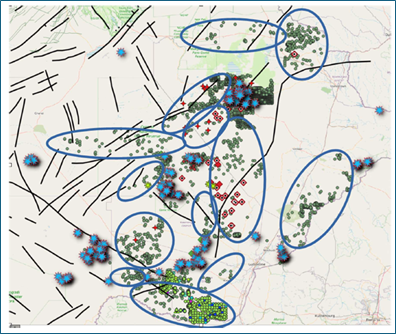
Figure 4: Example of kimberlite targeting, Botswana
With prospecting licences granted, the planned follow-up work includes high-resolution geophysics, indicator-mineral sampling, and prioritised drilling, starting at Jwaneng SW. The presence of slightly abraded diamonds there indicates a nearby source.
The AI’s value lies in its advanced dispersion modelling of BMIN’s extensive KIM database, which recognises directional trends, gravity-magnetic patterns, and low-mag, poor-ilmenite Group 2 kimberlite traits, characteristics often overlooked by conventional methods.
In summary, BMIN’s Botswana diamond portfolio now includes four new AI-defined project areas, in addition to KX36, Sekaka, and Maibwe. Each new licence could host one or more diamond-bearing kimberlites. Even a single economic discovery would be transformative, and these scientifically ranked targets give BMIN a renewed, high-impact exploration pipeline while preserving its proven legacy assets.